The Killer of Martyred Air Force Cadet Murat Tekin Exposes Himself
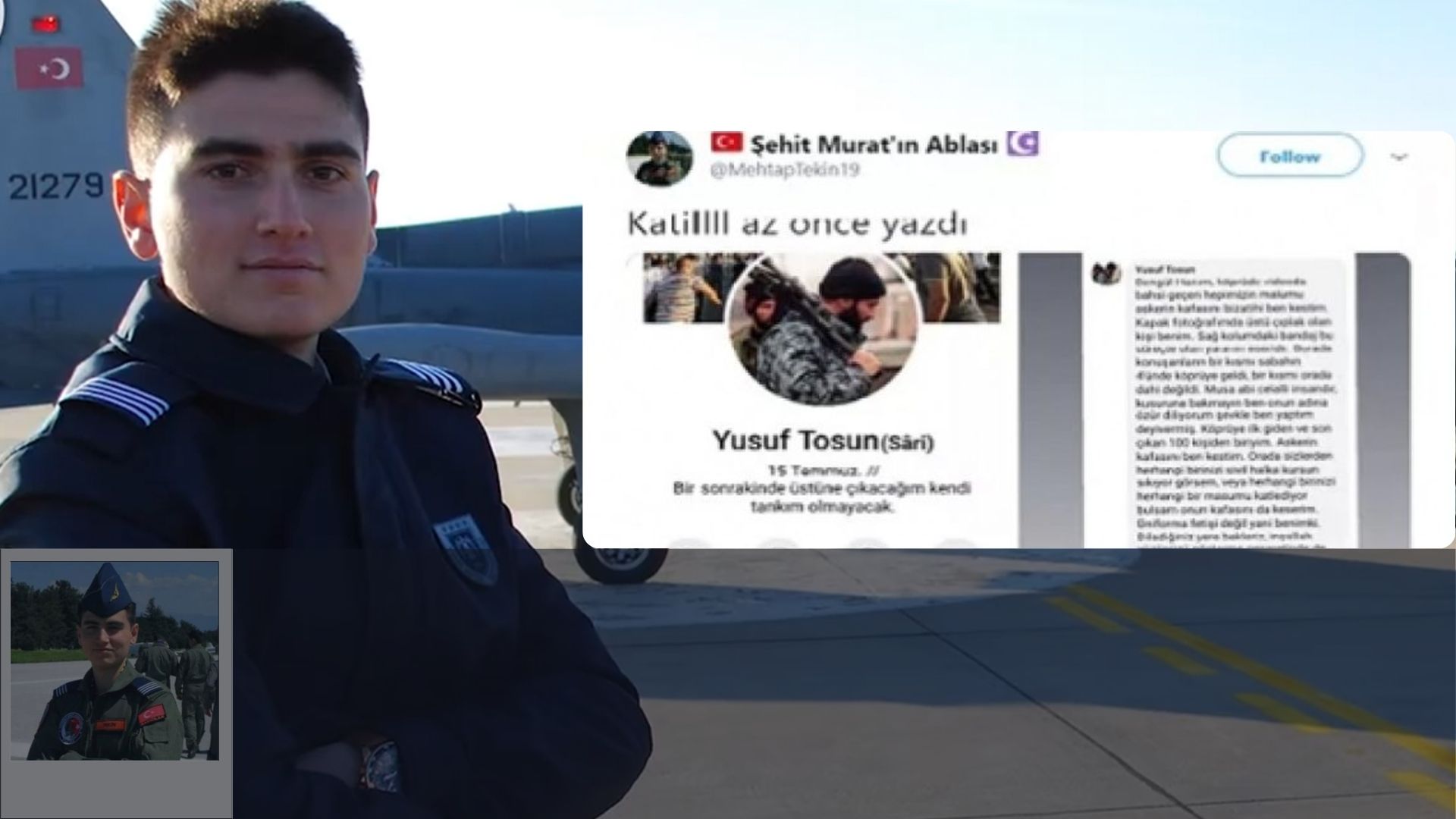

On the night of July 15, Air Force Academy cadet Murat Tekin, who was lynched and killed on the Bosphorus Bridge, was declared a martyr. His sister, Mehtap Tekin, shared on social media a series of threatening messages she had recently received. A user identifying himself as “Yusuf Tosun” sent her a message, introducing himself as “your brother’s killer”, effectively confessing to the crime and threatening her with death.
Photos and posts shared by Yusuf Tosun—showing him in a military uniform and posing with symbols linked to radical groups—sparked widespread outrage on social media. Despite the threats, Mehtap Tekin stated that she would not give up her pursuit of justice for her brother’s death.
According to the messages Mehtap Tekin shared, the account under the name Yusuf Tosun wrote the following:
“Ms. Bengül, in the video everyone talks about, I personally beheaded the soldier on the bridge. The person in my profile photo, bare-chested, is me. The bandage on my right arm is from an injury I got during that time. Some of those talking here weren’t even on the bridge at 4 a.m. Musa is a hot-tempered man; please excuse him for saying ‘I did it’ in zeal. I was among the first 100 to arrive and the last to leave the bridge. I cut the soldier’s head off. If I saw any of you firing at civilians or killing an innocent person, I would do the same to you. It’s not a uniform fetish for me. You’re welcome wherever you want to meet—just show your faces if you have the courage.”
“I was one of those who lynched the soldiers...”
Mehtap Tekin also exposed another threatening account belonging to a user named Musa Mert Özkaya, who wrote:
“That morning, I was one of the people who lynched the soldiers. I couldn’t get over my anger—we should have killed them all.”
“He would have become a pilot in two years”
Murat Tekin, a graduate of Bursa Işıklar Air Military High School and a student at the Turkish Air Force Academy, was about two years away from becoming a pilot when he was lynched on the Bosphorus Bridge.
The autopsy report revealed that the 21-year-old had his throat cut and was suffocated by pressure applied to his neck. His sister, Mehtap Tekin, recounted the events:
“Murat, who was deceived with the lie of a ‘military drill,’ was lynched. He could have been your son, your brother, your best friend. For some people, that’s exactly who he was—an irreplaceable wound. That’s what Murat has become: a lifetime of quiet ache. The rest is up to your conscience, because I don’t believe in any justice system other than conscience in these soulless times.
On the night of July 15, we thought he was at the training camp in Yalova. We learned about the events from TV. Our neighbor’s son, who was Murat’s classmate, was arrested, so we feared my brother might have been detained too. My parents searched for him in Istanbul but couldn’t find his name in any arrest or hospital list. For around ten days, we looked everywhere with no news. When we called the forensic office in İzmir, they told us to come in person.
On the 13th day, my father and uncle went to the Forensic Medicine Institute in Istanbul. At first, they couldn’t recognize him—he was unrecognizable. They left the morgue, but later, noticing his fingernail, they went back and identified him from the mark on his left hand. He used to say: ‘If I ever become a martyr, you’ll recognize me by my fingernail.’ And indeed, that’s how we recognized him. I saw him myself in the morgue. I had to see him with my own eyes.
His commander had woken them up that night saying, ‘We’re taking you to the most realistic drill of your life.’ Some cadets were told there were suicide bombers; others were told the president had been detained. Murat’s group was told about the bombers. They were brought to the Bosphorus Bridge and told to sleep on the bus. When they arrived, chaos erupted. Someone set fire to a public bus, the cadets panicked, and one shouted, ‘Don’t hurt them, they are students!’ My brother said, ‘I’m a student, I won’t do anything. I don’t even know what’s happening.’ His friend witnessed it.”
Attacked with knives
“Someone from the crowd kicked him in the chest, he fell, and they attacked with knives. I saw it myself in the morgue—his throat was slashed. The autopsy confirmed that. My brother was brutally murdered while knowing nothing about what was happening. When the cadets realized there had been a coup attempt, they tried to surrender, but Murat fell behind and couldn’t reach the police vehicle. Someone kicked him from behind, and he was lynched.
His friends who survived—many of whom were later imprisoned in Silivri—confirmed what happened. The video also supports this: someone asks, ‘Is he a lieutenant?’ unaware he was only a student. There were so many provocations that night; innocent young cadets were mistaken for coup soldiers.”
After Tekin’s body was released, the family received no official support in Istanbul. They chartered a private plane to İzmir, but were denied funeral services—no prayer call was made, and mosques refused to hold his funeral, citing government orders.
The forensic report concluded that Murat Tekin’s death resulted from "mechanical asphyxia due to neck compression and blockage of mouth and nose, along with blunt trauma injuries and stab wounds."


